The suitcases had been open on the bed since Tuesday.
Carol was a planner — had always been a planner — and the careful architecture of this trip reflected two decades of that personality. Printed itineraries in color-coded folders. A packing list laminated and checked twice. Confirmation numbers highlighted in three different colors because some things were too important to leave to memory alone. Twenty-five years of marriage deserved nothing less.
Rich watched her move through the bedroom with quiet admiration, folding a blouse with the kind of precision most people reserved for origami. He was sitting on the edge of the bed, thumbing through the excursion brochures she’d collected — whale watching off the Mendocino coast, a private wine tasting in Anderson Valley, a morning kayak rental on the Russian River.
“You know,” he said, holding up the kayak brochure, “I haven’t kayaked since my brother’s bachelor party. That was 1987.”
“You fell in,” Carol said without looking up.
“I did not fall in.”
“Rich.”
“I stepped out prematurely.”
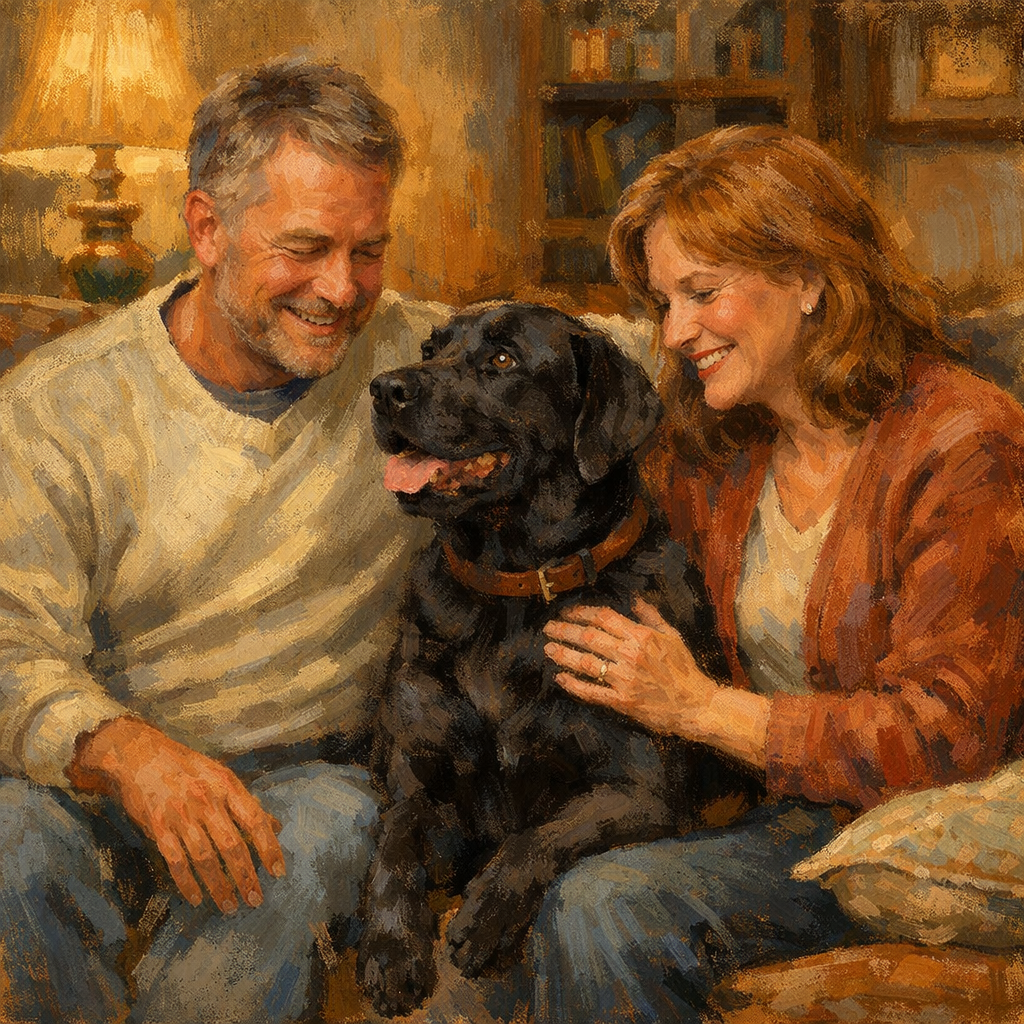
She laughed — that short, bright laugh he’d spent twenty-five years trying to earn — and tossed a rolled pair of socks at him. Bo lifted his heavy black head from the floor at the foot of the bed, assessed the situation, determined there was no food involved, and lowered it again with a sigh that seemed to come from somewhere philosophical.
“He knows,” Carol said softly.
“He doesn’t know.”
“Look at him.”
Bo was, objectively, looking at them with the particular expression of a dog who understood departure. His brown eyes tracked Carol as she moved to the closet, then shifted to Rich, then dropped to the suitcase on the floor as if reading its meaning exactly. His tail did not wag.
“He’s fine,” Rich said. “He loves it at Pinebrook. Remember last time? They said he was the most popular dog there.”
“He cried when we picked him up.”
“That was joy.”
Carol pressed her lips together in the way that meant she wasn’t conceding the point but had chosen more important battles. She laid a sundress into the suitcase with the care of someone packing a relic.
Tomorrow morning. Flight out of Columbus at 7:15, connection in Denver, landing in Santa Rosa by early afternoon. The B&B in Healdsburg had a claw-foot tub and a vineyard view and Carol had shown Rich the photos enough times that he felt he’d already been there. Twenty-five years. It felt right to mark it with something that cost a little more than they should spend and lasted a little longer than the weekend.
They ordered Thai food that night, ate it on the couch with Bo arranged across both their feet, watched half a movie neither of them were really watching, and went to bed early the way people do when tomorrow is something they’ve been waiting for.
The call came at 11:17 the next morning.
Rich saw the number — Pinebrook Pet Lodge — and answered it with the reflexive cheerfulness of someone expecting a confirmation.
What he got instead was a long pause, and then a woman’s voice wrapped tightly around an apology.
Her name was Diane. She was the facility manager. She was so terribly sorry. There had been an error — a software migration over the weekend, reservations transferred between systems, and somehow — she couldn’t explain exactly how — Bo’s booking had not carried over. They were at full capacity. Had been since Monday. She’d only just now cross-referenced the week’s drop-offs against their current roster and realized the gap.
“I understand you leave tomorrow,” she said. “I am so, so sorry.”
Rich stood in the kitchen for a moment after hanging up. Through the window above the sink, he could see the backyard — Bo’s tennis ball in the grass, faded and soft from a hundred retrievals.
He went to find Carol.
She was in the living room on her laptop, reviewing the driving directions from the Santa Rosa airport to the B&B for what was probably the fourth time. She looked up and read his face before he said a word.
“What happened.”
It wasn’t a question. It was the voice she used when she already knew something had gone wrong and was bracing for the shape of it.
He told her. Calmly, carefully, in the way he delivered bad news — directly, without cushioning that would only delay the impact. When he finished, Carol was quiet for a moment that stretched long enough to become its own kind of weather system.
“No,” she said.
“Carol —”
“No, Rich, we have been planning this trip for eight months. Eight months. The reservations, the excursions, the — we are celebrating twenty-five years —”
“I know.”
“Call them back. Tell them to figure it out.”
“They’re full. There’s nothing to figure out.”
“Then we’ll find somewhere else.” She was already reaching for her phone. “There are other boarding places. We’ll find someone.”
They tried. Rich worked his phone at the kitchen table while Carol worked hers from the couch, and for forty-five minutes they moved through every option available — Pinebrook’s competitor across town, the vet’s office that sometimes boarded, the groomer on Henderson Road who Carol vaguely remembered had kennels in the back. Full. Full. No vacancy until the following week. One place said they might be able to fit Bo in but couldn’t promise adequate supervision overnight, and both Rich and Carol arrived at the same silent conclusion about that option without needing to discuss it.
Carol sat down at the kitchen table across from Rich. Bo came and rested his chin on her knee, and she put her hand on his head without thinking, the way you breathe.
“We could ask your sister,” Rich said.
“Her apartment doesn’t allow dogs. You know that.”
“Dave and Patricia —”
“Are in Florida until the fourteenth. I already thought of them.”
The clock on the microwave read 12:44. Their flight was at 7:15 tomorrow morning. The airport was forty-five minutes away. The alarm was already set.
“We could just go,” Rich said quietly. It cost him something to say it. “Board him somewhere we’re not totally comfortable with. It’s only six days.”
Carol looked at him. Then she looked at Bo — his liquid eyes, the gray that had begun appearing around his muzzle in the last year, the absolute and uncomplicated trust in his expression.
“I can’t do that,” she said. “I won’t do that.”
And that was the end of the decision, really. Everything after was just logistics.
Rich called the airline first. The cancellation penalty was significant — they were inside the window. He absorbed it without complaint. Carol called the B&B in Healdsburg, and the woman who answered was kind about it, genuinely kind in the way that made it somehow worse, and offered to apply half their deposit toward a future reservation. The whale watching tour was non-refundable. The wine tasting returned a partial credit. The kayak rental, cheerfully, had no cancellation fee at all.
By three in the afternoon it was done. The suitcases sat on the bed, still packed, suddenly artifacts from a trip that wasn’t going to happen.
That night was quieter than the previous one. They ordered pizza this time. Bo seemed to understand that something had shifted — he stayed close, moving from room to room behind Carol with the patient devotion that had defined him since he was eight weeks old and could be carried in one arm. When they went to bed he jumped up between them, which they normally didn’t allow, and neither of them said a word about it.
The next morning arrived anyway, the way mornings do regardless of whether you have anywhere to be.
Rich was up by six-thirty out of habit. He made coffee, let Bo out into the backyard, stood at the kitchen window watching the dog move through the early light with his nose to the ground, cataloguing the night’s developments — a rabbit, probably, along the fence line; something interesting near the garden bed. Simple work. Important work, by his accounting.
Carol came down around seven-thirty, poured her coffee, and didn’t say much. There wasn’t much to say. They’d been together long enough that silence was its own language, and this particular silence said: I’m sad, you’re sad, we made the right call, let’s just be sad for a little while.
By nine o’clock Rich was on the couch with the television on at low volume, not really watching. Carol had retreated to the sunroom with a book she wasn’t really reading. Bo was asleep on the floor, legs running slightly, chasing something in a dream.
The morning news was doing what morning news does — a city council dispute, a ribbon cutting, the weather, a human-interest story about a high school robotics team. Rich watched it with the passive attention of a man who had nowhere to be.
Then the anchor’s expression changed. That specific shift — the almost imperceptible straightening, the tone dropping half a register — that signals a break from the ordinary.
“We’re getting reports this morning of a midair collision involving two aircraft over the Colorado Rockies. We have limited information at this time, but we can confirm that one of the aircraft involved was a commercial flight —”
Rich sat up.
“— early reports indicate the flight originated in Columbus, Ohio, with a scheduled connection in Denver —”
He set down his coffee mug.
“— we’re working to confirm the flight number, but sources are reporting that it was operated by Meridian Airlines —”
His voice, when it came, didn’t sound like his voice.
“Carol.”
She didn’t hear him.
“Carol.” Louder. “Come in here. Right now.”
She appeared in the doorway with her book still in her hand, registered his face, and crossed the room. She sat beside him on the couch as the coverage expanded — a reporter now, standing in front of a chyron that was still being populated with information, the flight number appearing letter by letter.
They both saw it at the same time.
Flight 2247. Columbus to Denver. Meridian Airlines.
Departed 7:15 a.m.
Carol’s book hit the floor and neither of them reached for it.
The details came slowly, then all at once, the way these things do. A small chartered aircraft, cause unknown, had intersected the commercial flight’s path over the mountains outside Glenwood Springs. Both aircraft had gone down. Search and rescue teams were en route. There were no reported survivors. All passengers and crew aboard Flight 2247 were confirmed lost.
All passengers and crew.
Carol brought her hand up over her mouth. Rich found her other hand on the couch cushion and held it, and neither of them spoke, because there were no words assembled in the English language adequate to the particular silence that follows the understanding of a thing like this.
They would have been at cruising altitude over western Colorado at that exact moment.
They would have been in seats 14A and 14B, which Rich had selected specifically because Carol preferred the window.
They would have been gone.
The television continued. A spokesman at the airline. Aerial footage of a mountainside. A phone number on the screen for family members to call.
Beside the couch, Bo stirred from his dream. He raised his head and looked at them both with those careful brown eyes, reading the room the way he always did, and then he stood and walked to Carol first — pressed his broad head against her knee and held it there. She put both arms around his neck and bent over him and said nothing, said everything.
Rich reached over and laid his hand on the dog’s back, felt the warmth of him, the steady breathing, the impossible ordinary aliveness of him.
A software error. A dropped reservation. A bad situation they’d refused to force Bo into just so they could keep to a schedule.
A five-year-old black Labrador, asleep on their feet on a Tuesday night, running in a dream along a fence line.
Rich pressed his face into the soft fur behind Bo’s ear.
“Good dog,” he said, barely a whisper, barely a breath.
Good dog.