Troy Mercer had always been a man of discipline. Five-thirty wake-ups. Protein shakes. A twelve-year career in financial risk assessment that rewarded the kind of careful, measured thinking that made him good at his job and, frankly, a little boring at dinner parties.
Which is probably why, when his college buddy Derek texted him a link to an online sports betting platform in early October, Troy figured it couldn’t hurt. A hundred bucks here and there. Something to make the Sunday afternoon games mean something when the Browns were already out of playoff contention and the couch was pulling him toward sleep.
He won sixty dollars his first weekend. Then two-twenty the next.
By the third week, he’d stopped calling it fun.
Jen noticed it the way wives notice things — not all at once, but in small accumulations. The way his phone never left his hand. The way he’d grown quiet at dinner, mentally absent even when physically present, his eyes carrying the glazed, calculating look of someone running numbers. She asked about it once, lightly, the way you test ice before committing your full weight.
“It’s just the games,” Troy said. “I’m fine.”
She believed him because Troy had always been the steady one. The planner. The man who read insurance policies in full and kept a color-coded spreadsheet of their household expenses. If Troy said he was fine, fine was probably accurate.
He was not fine.
The losses had begun the fourth week, arriving the way avalanches do — not catastrophically at first, but with an unsettling momentum. He’d chased a bad Monday night bet with a bigger Thursday night bet. Then a weekend parlay. Each loss felt like a temporary setback, a statistical outlier that the next bet would correct. He was, after all, a risk analyst. He understood probability. He understood expected value.
What he hadn’t understood — what no spreadsheet had ever prepared him for — was the specific neurological cruelty of a near-win. The three-leg parlay that fell apart in the fourth quarter. The boxer who went down in the ninth round of what was supposed to be a twelve-round fight. Each near-miss felt less like a loss and more like an injustice, something owed to him, a debt the universe was carrying that would eventually have to be repaid.
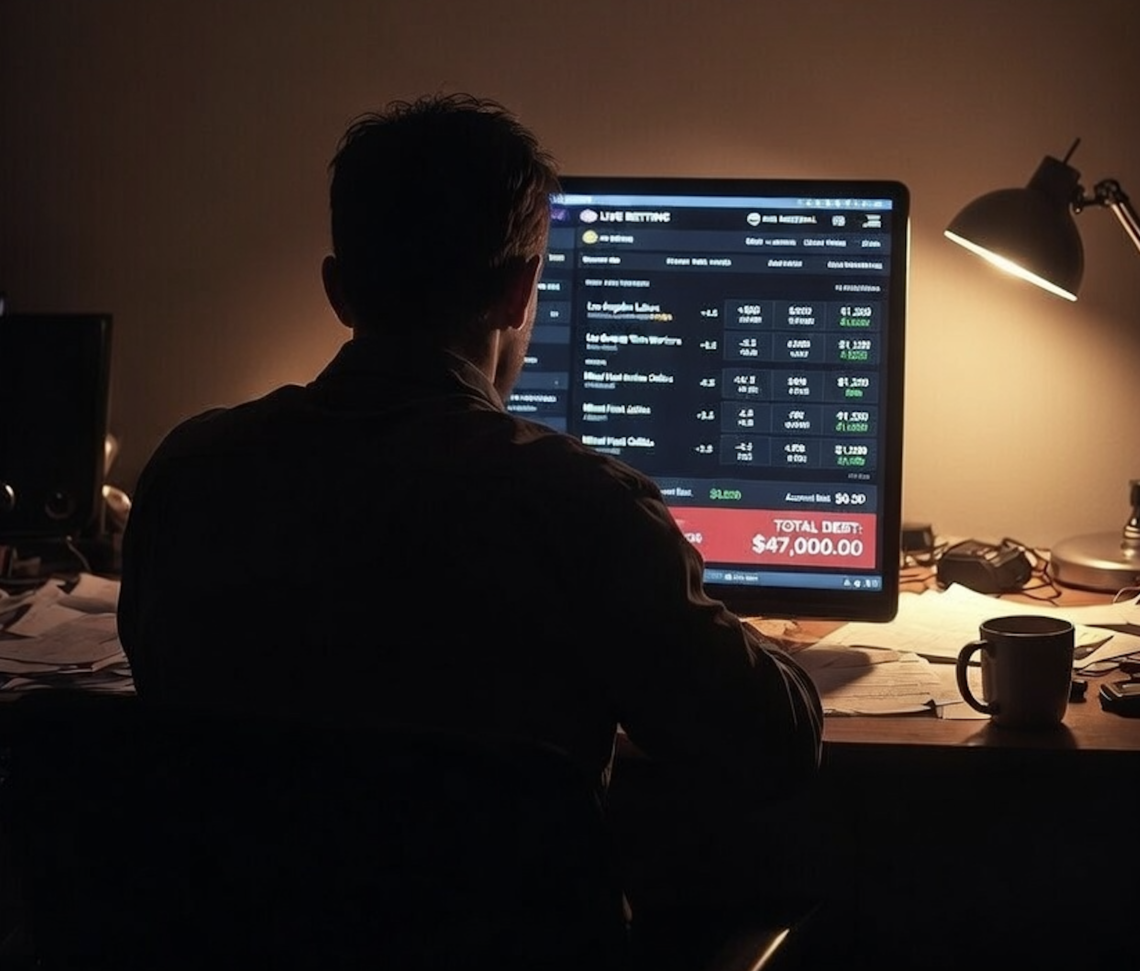
By the sixth week, he owed the platform $47,000. By the seventh, it was $61,000.
He’d moved money between accounts three times. Told Jen the furnace estimate was worse than expected. Told himself he was one good weekend from fixing all of it.
It was a Wednesday night in mid-November when everything changed.
Jen was at her book club. Troy sat in the home office — their spare bedroom converted into something aspirational — with three browser tabs open and a yellow legal pad covered in calculations that increasingly resembled the work of a man trying to solve an equation that had no solution. He’d been at it for two hours. The light outside had gone fully dark, and the neighborhood’s polite suburban quiet had settled in around the house like a held breath.
His phone buzzed.
A text. Unknown number. No area code he recognized.
You’re in deep, aren’t you?
Troy stared at it. His first instinct was that Derek had somehow found out, or maybe one of the guys from the platform’s VIP chat had gotten his number. He typed back: Who is this?
A friend. Or I could be. Depends on how things go.
How’d you get this number?
Same way I know you’re sitting in your home office right now with $61,400 in losses and three browser tabs open. The middle one is a parlay calculator. It’s not going to work, Troy.
He stood up from his chair so fast it rolled back and struck the wall. He looked at the window. The blinds were closed. He crossed the room and opened them — nothing but his own dark reflection and the quiet street beyond.
What do you want? he typed.
To help. That’s genuinely all I want. I know someone. Someone who has access to information about a game this Saturday that would make your situation disappear entirely. Correct amount wagered, correct pick, and you walk away clean. Better than clean.
Troy sat back down slowly. He’d heard of game-fixing. Had read about it the way people read about plane crashes — as a thing that existed but not as a thing that touched his life.
That’s illegal, he wrote.
So is moving $23,000 out of your joint savings account without telling your wife. But here we are.
His stomach dropped. He put the phone face-down on the desk and sat there breathing. Then he picked it back up.
What’s the catch?
There’s a service agreement. Standard terms for this kind of arrangement. I’ll send it over — you read what you like, sign at the bottom, and I’ll give you the pick. You place the bet. You win. We’re square.
And if I don’t want to sign?
There was a pause — longer than the others. When the reply came, it was brief.
Then I hope the parlay calculator works out.
The contract arrived seventeen minutes later. It was long — Troy scrolled through it and estimated sixty, maybe seventy pages of dense text, the kind of language that lived in the sub-basements of legal documents where no one ever ventured. There were sections on “Consideration and Reciprocal Obligation.” Sections on “Duration of Terms” and “Transferability of Liability.” A clause near the end, in type so small he had to pinch-zoom twice, referenced something called “Eternal Jurisdictional Consequences,” which he took for boilerplate.
He read the first four pages carefully. Then the last two. The middle, he skimmed.
He told himself he was a risk analyst. He knew what he was doing.
He typed: I’ll sign.
The contract sent back a signature field. He signed with his finger, his name rendered in a childlike scrawl across the screen. Hit submit.
Good, came the reply. Saturday. 4 PM. Kansas City minus two and a half. Every dollar you can put on it.
He put $63,000 on it. Money he didn’t have bet against a margin he’d been given by someone he didn’t know. He sat on the couch Saturday afternoon with Jen beside him, who thought he’d placed a friendly hundred with Derek’s group. She had her legs folded beneath her and a glass of white wine, happy and unaware, and Troy watched the game with his heart trying to exit his chest through his sternum.
Kansas City won by ten.
He sat very still for a long moment after the final whistle.
Then he went to the bathroom and gripped the sink and looked at himself in the mirror — really looked, the way you rarely do — and thought: I did it. It’s over.
His phone buzzed.
Congratulations. Enjoy the weekend. I’ll be in touch.
He pocketed the phone and went back to the couch and let Jen refill his glass and said nothing, and felt something he couldn’t quite name — not relief, exactly. Something thinner than relief. Something that skittered away when he tried to look at it directly.
The call came the following Tuesday.
Not a text this time. A call, from the same number, and the voice on the other end was pleasant in the way that expensive knives are pleasant — refined, precise, and capable of considerable damage.
“Troy. Time to talk about the arrangement.”
“The arrangement’s done,” Troy said. He was in the parking garage at work, the concrete cold and echoey around him. “I placed the bet, I won. We’re square, you said so.”
“I said you won. I didn’t say we were square.” A sound that might have been a laugh, or might have been something else entirely. “Did you read the contract, Troy?”
“I read it.”
“The reciprocal obligations section. Pages thirty-one through forty-four. Did you read that part?”
He had not read pages thirty-one through forty-four.
“There’s a man,” the voice continued. “His name and address will be sent to you. There’s something I need done. Something you’re going to do for me, because you agreed to. Because it’s written down with your signature attached, and the jurisdiction that contract falls under makes your county courthouse look like a suggestion box.”
Troy’s back hit the concrete pillar behind him. “I’m not going to—”
“There are other items as well. Several. Some will be unpleasant. None of them are negotiable.” The pleasantness in the voice hadn’t moved an inch. “I want to be very clear about something, because I believe in transparency, which is more than most in my position can say. If you choose not to honor the agreement, the consequences extend beyond you. Your wife. Your parents. Derek, who you haven’t called since this started, which he’s noticed. Everyone you love. And the consequences aren’t merely mortal, Troy.”
He thought about the clause. Eternal Jurisdictional Consequences.
“What are you?” he whispered.
“The counterparty to your contract,” the voice said. “Whom you reached via a freely downloaded gambling application, using a credit card you applied for without Jen’s knowledge, at two-seventeen in the morning on a Wednesday, alone in a room, making a choice that felt very small at the time.” A pause. “They always do.”
The line went quiet, but not dead — he could feel the connection still open, waiting.
“I’ll send you the first name tonight,” the voice said finally. “You’ll want to get some sleep. The next few weeks are going to require a clear head.”
The call ended.
Troy stood in the parking garage for a long time. Above him, fluorescent lights buzzed with a frequency that felt almost like language. Around him, other people’s cars sat patient and ordinary in their spaces. Somewhere above, thirty floors of colleagues were eating lunch at their desks, arguing about projections, complaining about the printer.
His phone buzzed. A name. An address. A date.
He thought about Jen on the couch with her wine, unbothered, safe in the assumption that Troy was the steady one. The planner. The man who read the fine print.
He put the phone in his pocket and walked to his car and sat inside it for a long time in the dark, and the worst part — the part that would stay with him through everything that followed, that would visit him in the smallest hours of every remaining night — was that he couldn’t even say he hadn’t been warned.
It had all been right there in the contract.
He just hadn’t read it.
Later, when Troy tried to describe it to the priest he’d never been to see before and never would again, he searched for the word that fit the feeling of that moment in the parking garage — the specific texture of it. He’d expected fear, and there was fear. But underneath the fear was something almost worse: the dull, familiar weight of a man who has done the math too late and found the numbers exactly as bad as he’d refused to imagine.
A risk analyst.
He almost laughed.
Almost.