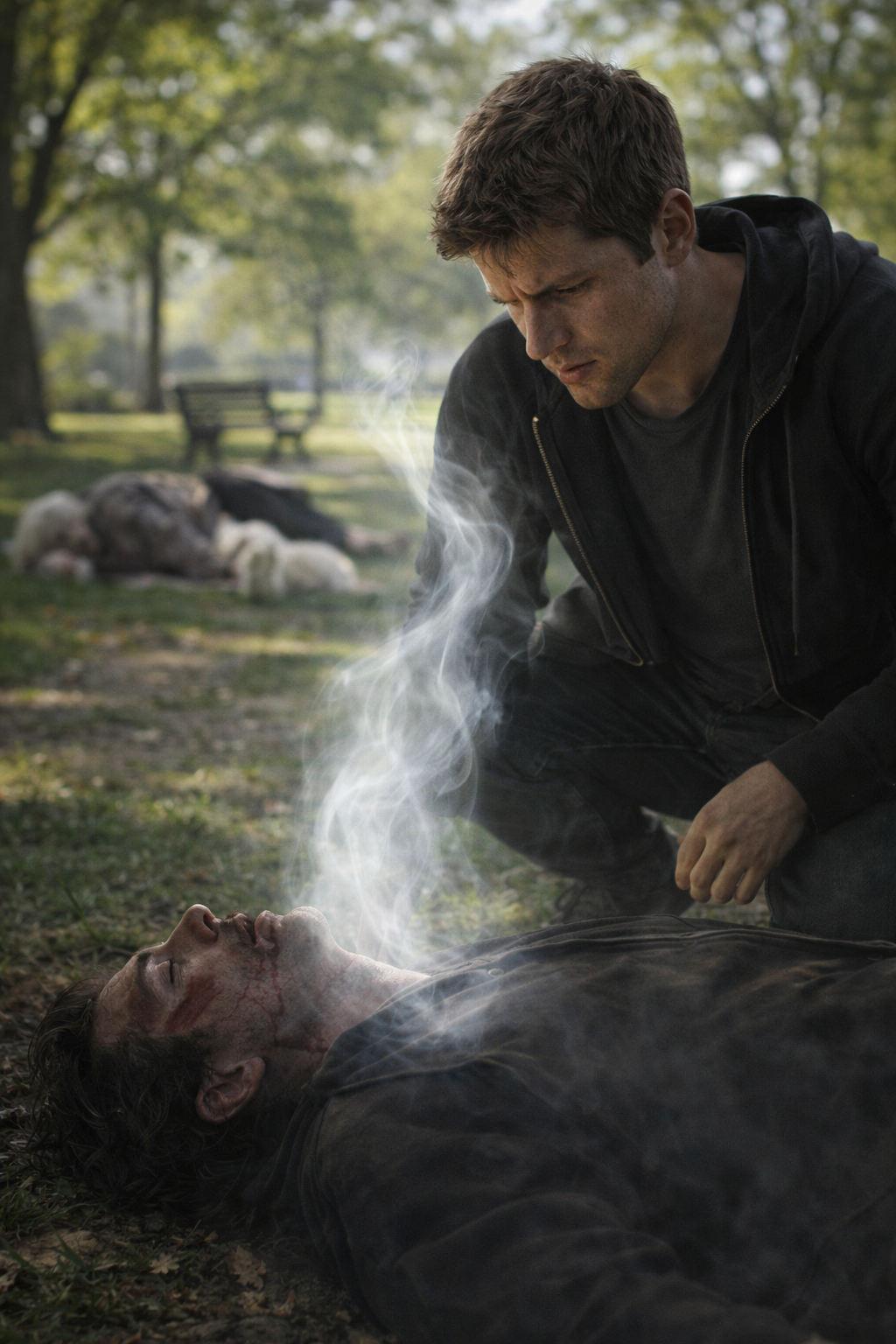
The first thing Daniel noticed was the silence.
Not the ordinary quiet of a city park after screaming stops and sirens start. Not the breathless, stunned hush of people trying to understand what they had just seen. This was something thinner, stranger, as if the world itself had taken one careful step backward.
He was on one knee in the grass, his right hand still wrapped around the grip of his handgun, his pulse hammering so hard it shook his wrist. Ten feet away, a woman in a blue coat sobbed into both hands. Beyond her, under the yellow glare of a lamp, a paramedic knelt beside the older woman sprawled on the walkway, while another worked over the younger one who had tried to intervene.
The little white dog lay near its owner like a dropped toy.
Daniel looked down.
The killer was on his back in the grass, eyes half-open, mouth parted, chest still.
There was blood on the man’s shirt, blood on his jaw, blood darkening the front of the gray hoodie he’d worn despite the mild afternoon. The hunting knife lay off to one side where it had spun from his hand after the second shot. Daniel remembered firing once, then again, then again, until the man lurched sideways and collapsed hard enough to shake the leaves.
He had done what he had to do. Everyone had told him so already.
You saved lives.
You stopped him.
If you hadn’t acted, he would have killed her too.
But what Daniel would remember later, lying awake in the dark, wasn’t the knife, or the shots, or the look on the younger woman’s face as she clutched her side and staggered back.
It was what came after.
He had knelt because he’d been trained to make sure the threat was over. The man’s eyes had fixed on his face with a raw, animal hatred that should not have still been there. A wet rattle had slipped from the murderer’s throat. Then a white thread had emerged from his open mouth.
At first Daniel thought it was breath in the cooling air.
Then the thread thickened.
It rose, twisting softly, not like smoke and not like steam, but like something choosing its shape. It gathered above the dead man’s chest, pale and almost luminous, and for the span of a heartbeat Daniel saw the outline of a face inside it—gaunt, open-mouthed, furious.
It tilted toward him.
He jerked back so sharply he nearly fell, and the shape unraveled at once, thinning into the late-day light until there was nothing there at all.
“Sir? Sir, are you injured?”
A police officer was crouching beside him. Daniel realized his gun was still in his hand and let the officer guide it gently away.
Later, after statements, after fluorescent lights and paper cups of water and a detective repeating the same questions in three slightly different ways, Daniel was sent home.
The news vans were already gathering outside the precinct by then. One of the officers walked him out a side door to avoid cameras. The detective clapped him once on the shoulder and told him he should try to get some sleep.
“As much as you can, anyway.”
Daniel nodded like a man receiving instructions in a language he barely understood.
By the time he reached his apartment building, evening had fallen fully over the city.
He lived on the fourth floor in a one-bedroom that overlooked a narrow street lined with sycamores and dented sedans. It was usually a comfortingly forgettable place. Neutral walls. A sagging gray couch. Books he meant to read and dishes he meant to wash. The kind of apartment that belonged to a man who worked long hours, paid his bills on time, and rarely thought of himself as the main character in anything.
Inside, he locked the door, leaned his forehead against it, and exhaled.
The apartment smelled faintly of coffee and dust and the detergent he used on his sheets. Familiar. Harmless.
He set his keys on the kitchen counter and noticed his hand was trembling. There was dried blood along the knuckles. Not his.
He scrubbed his hands in the sink until the water ran pink, then clear, then pink again where he’d missed a spot near the nail bed. He scrubbed until the skin burned. When he finally looked up, his own reflection startled him.
He looked older. Or simply less certain.
There was a cut over his eyebrow he did not remember getting. His dark hair clung damply to his forehead. His face seemed oddly hollow around the eyes.
He thought of calling someone. His sister, maybe. Or Adam from work. But the idea of speaking, of explaining, of hearing sympathy in someone else’s voice, felt impossible. He set his phone facedown on the counter and wandered into the living room.
The television turned on without sound. He watched moving lips beneath a bold headline about the park attack. A photo of the killer flashed on-screen: mug shot lighting, hard eyes, thin mouth. Daniel muted it anyway, though it was already silent.
He sat.
Three minutes later, something tapped from the kitchen.
A small, metallic sound. Like a spoon lightly striking the side of a mug.
Daniel looked over his shoulder.
Nothing.
He told himself the pipes were settling. Buildings made noise. Refrigerators clicked on. Ice shifted in freezer trays. He knew this. He had always known this.
He stayed on the couch until the tap came again.
Then once more.
He got up and checked the kitchen. The sink was empty. No mug. No spoon.
He opened the freezer, then shut it. He checked the windows, though there was no reason to. The blinds were half-drawn, the glass reflecting back only the room behind him and his own warped shape in the dark.
A laugh drifted faintly from the television.
Daniel turned. The volume was still muted.
He crossed the room in three strides, snatched up the remote, and switched the set off.
The room fell still.
He stood there breathing through his mouth, listening.
From the hallway outside his apartment came the muffled clank of an elevator door, a burst of conversation, footsteps receding. Ordinary sounds. Human sounds. They steadied him a little.
He poured himself two fingers of whiskey and drank them too fast. Heat slid down his throat. He poured another.
It was a little after nine when the lights in the kitchen dimmed.
Not a full flicker. Just a gentle lowering, as if something had passed over the apartment like a cloud.
Daniel froze.
The living room lamp weakened, recovered, weakened again. The overhead light above the stove hummed softly.
Then all of them brightened at once.
He let out a laugh that sounded nothing like amusement. “Great.”
The building wiring was old. Hadn’t the superintendent mentioned that? Last winter, maybe. Or had Daniel imagined that too?
He drank the second glass more slowly. He put the bottle away. He checked the deadbolt again.
At ten, he went into the bedroom.
He did not want to sleep, but exhaustion was moving through him now in heavy waves, dragging his thoughts apart. He changed clothes, washed his face, and stood for a long moment beside the bed staring at the rumpled blankets as if they belonged to someone else.
The bedroom window was cracked an inch. He was certain he had not opened it.
Cold air feathered the curtain inward.
Daniel crossed the room and shut it. As he latched the window, he looked down into the street below. A single pedestrian hurried under a streetlamp, shoulders hunched. A bus hissed at the corner. Nothing unusual.
But when he looked at the reflected glass, he saw someone standing behind him.
Just for an instant.
A tall shape in the bedroom doorway. Head bent slightly to one side. Still as a coat on a hook.
Daniel wheeled around.
The doorway was empty.
His heart slammed so hard it hurt. He grabbed the baseball bat from the closet—an old college relic he kept more out of habit than fear—and went room to room turning on lights. Kitchen. Bathroom. Living room. Front hall. Closet. Shower curtain pulled back.
Empty.
When he returned to the bedroom, the window was open again.
Not cracked. Open.
A night breeze stirred the sheets.
Daniel stood there gripping the bat until his hand cramped. The room smelled wrong now, faintly earthy and damp, like wet soil turned over by a shovel.
He shut the window for the second time and locked it.
Then he heard the footsteps.
Soft. Slow. Not in the room. In the apartment.
A measured tread on the hardwood, coming from the living room toward the hall.
One step.
Then another.
Daniel moved to the bedroom door and listened, every muscle locked.
The footsteps stopped just outside.
He could hear nothing else. No breathing. No rustle of clothing. Just a pressure on the other side of the threshold, a sense of presence so dense it seemed to bend the air.
Daniel swung the door open with the bat raised.
The hall was empty.
But the bathroom light, which he had left on, was now off.
He stared at the dark rectangle of the bathroom doorway.
“Who’s there?”
His own voice sounded flat and foolish.
He backed into the bedroom, set down the bat, and snatched up his phone. No signal. Not low bars. No bars.
That was impossible. He had signal in every corner of the apartment.
He moved to the window. Nothing. He stepped into the hall. Nothing.
The bathroom door creaked.
It was only partly open now. He had left it wide.
Daniel took one step toward it, then another.
The smell of damp earth grew stronger.
Inside the bathroom, the medicine cabinet mirror was fogged over from edge to edge.
In the center of the glass, traced by a finger from the inside or outside—he could not tell which—was a single word.
LOOK
Daniel stumbled backward. The phone slid from his hand and hit the tile.
From the tub came a soft chuckle.
Not loud. Not theatrical. A private, delighted sound, like someone trying not to laugh in church.
Daniel ran.
He fled into the living room, grabbed his keys, and yanked open the apartment door.
The hallway outside was gone.
Beyond the threshold was not the fourth-floor corridor with its beige carpet and numbered doors. It was the park path.
Gray daylight. Bare trees. A bench. Leaves blowing across concrete.
And there, twenty yards away, stood the killer in his blood-dark hoodie, holding the hunting knife at his side.
His face was wrong. Paler than paper, eyes sunk deep and glistening. The bullet wounds showed black through the fabric. Yet he stood easily, smiling.
Daniel slammed the door and staggered back, choking on his own breath. When he looked again, the ordinary hallway was there through the peephole, empty and fluorescent-lit.
He turned in a circle, half-expecting to find the thing behind him already.
The apartment had changed.
The corners seemed deeper. The ceiling higher. Shadows pooled where they should not. The television screen, dark and dead, reflected movement that was not in the room.
Daniel snatched up the bat again.
“Why me?” he shouted, the words ripping out of him. “I stopped you. You were killing people!”
His answer came from every room at once, a whisper layered over whisper, male and wet and intimate.
“You looked.”
The lamp beside the couch burst.
Glass sprayed the rug. Darkness leaped across the room, broken only by the streetlight glow leaking through the blinds.
Daniel backed toward the kitchen. Cabinets banged open one after another. A drawer shot out and crashed to the floor. Forks and knives skittered over tile like silver insects.
He raised the bat as the refrigerator door eased slowly open.
Inside, the pale interior light revealed nothing at first except cartons and shelves.
Then the head of the Maltese rolled gently from the top rack and thumped to the floor.
Daniel made a broken sound and swung the bat into the refrigerator so hard the bulb shattered. He ran again, sobbing now without knowing it, into the bedroom and slammed the door behind him.
The walls shuddered with impacts from the other side.
Once.
Twice.
Then silence.
Daniel stood in the center of the room, chest heaving. The bat hung useless in his hand. He wanted to pray but found he had forgotten every prayer he’d ever known.
The silence stretched.
At last, slowly, the doorknob began to turn.
Daniel stared.
The knob turned all the way right. Held. Then all the way left.
The latch clicked.
The door opened inward a few inches.
No one stood there.
Beyond it, the apartment was dark.
Daniel could hear something breathing just outside his line of sight.
A shape moved low across the floor—mist, maybe, or shadow, white-gray and purposeful. It slipped under the bed.
The mattress dipped.
Just slightly. The unmistakable weight of someone climbing onto it from the far side.
Daniel backed into the wall. “No.”
The dip moved slowly across the mattress toward his pillow.
He bolted past the bed and into the hall. Nothing touched him. Nothing chased him. Which was somehow worse.
In the living room, his front door stood wide open to the normal corridor. Yellow hall light pooled onto the rug.
Relief nearly broke him.
He ran for it.
Just before he crossed the threshold, a hand seized his ankle.
Daniel crashed forward, smashing his shoulder against the frame. Fingers like frozen wire clamped around his leg and dragged him backward over the floorboards. He kicked wildly, clawing at the rug, but the unseen grip only tightened.
Then the killer was there.
Not emerging or appearing. Simply there, kneeling over Daniel exactly as Daniel had knelt over him in the park.
His face was inches away.
The dead eyes were milk-pale. The mouth smiled too wide. Dirt packed the gums. The skin around the bullet wounds looked wet and rotten.
“You looked,” he whispered again.
Daniel tried to scream. The thing’s left hand pinned his throat. Its right hand rose empty, but as Daniel watched, the fingers curled around nothing and closed on the shape of the hunting knife. The blade shimmered into sight like metal condensing from fog.
Daniel shoved upward, desperate, and the specter blurred. For one hopeful second he thought it was weakening.
Instead it flowed around him and into him.
Cold exploded through his chest.
He convulsed. Every nerve lit at once with pain so immense it was almost bright. He felt his own memories shake loose: childhood fever, first kiss, his mother laughing, the park, the shots, the white thread rising. Beneath all of it came someone else’s memories, jagged and violent—rage in narrow rooms, stray animals cornered for sport, the hot pleasure of domination, the thrill of causing terror with nothing but a smile.
Daniel understood then.
The thing in the apartment was not haunting him out of spite alone. It had not followed the one who had killed it. It had followed the one who had seen it leave.
The one who had noticed.
The one who had opened, in that instant of contact, some small unguarded door.
The cold withdrew.
Daniel collapsed on his side, gasping.
The room was quiet again.
The front door was closed. The lamp was broken. The kitchen drawers were open. But the pressure had lifted, leaving behind only emptiness and the pounding ache in his chest.
It was over, he thought. God, maybe it was over.
He crawled to the couch, dragged a blanket down over himself, and lay there shaking until exhaustion finally drowned fear.
Sometime after midnight, he fell asleep.
He dreamed of the park.
Not the attack. The silence after.
In the dream he was kneeling again over the dead man while wind moved softly through the grass. The white spirit rose as before, but this time it did not come toward him.
It hovered over the corpse and looked down, as if considering.
Then it smiled and drifted away.
Daniel woke once in the dark to the sensation of someone standing over him.
He could not move. Sleep held him like wet plaster.
Through barely parted lids he saw a figure at the foot of the couch, tall and motionless, moonlight from the window shining faintly through it. Its face was hidden, but he knew it.
He tried to shout. Nothing came.
The figure bent over him.
A cold hand pressed lightly to the center of his chest, almost tenderly, exactly where the thing had entered him hours before.
Then it pushed.
There was no wound. No blade. Just a terrible inward force, as if invisible fingers had reached between his ribs and closed around his heart.
Daniel’s eyes flew open.
The specter leaned close, and now he could see the face clearly—bloodless, delighted, no longer angry. Satisfied.
Retribution completed.
Daniel’s body arched once beneath the blanket. His mouth opened. A small, dry sound escaped. Then his limbs loosened.
The pressure on his chest remained a moment longer.
When it lifted, a pale mist slipped from Daniel’s mouth into the room.
It rose uncertainly, trembling, only half-formed, as if not yet sure what it was.
The killer’s spirit watched it with patient interest.
Outside, a siren passed somewhere in the sleeping city. A branch scraped softly against the building. In the apartment across the hall, someone laughed at a television sitcom, unaware.
The two pale shapes faced one another in the darkness.
Then, together, they turned toward the bedroom window, which slowly unlatched itself and swung open to the night.